🎁 Free Prepress Resource
Download the 25-Point FDA Compliance Checklist (PDF)What are the mandatory elements of a nutrition label? According to global FDA and EU guidelines, a compliant Nutrition Facts panel must follow a strict nutrient order. It must include Energy/Calories (in bold), mandatory nutrients (Total Fat, Sodium/Salt, Total Carbohydrates, Protein), and a strict Allergen Declaration. Furthermore, all typography must follow specific minimum font size and stroke weight requirements.
Designing FMCG (Fast-Moving Consumer Goods) packaging is not just about creating beautiful brand aesthetics; it is about navigating a minefield of federal laws. The Nutrition Facts panel is the most strictly regulated piece of real estate on your entire box, bag, or bottle.
A single typo, a font size that is 1pt too small, or a poorly formatted allergen warning can trigger a mandatory product recall. Meeting these food labeling requirements is critical. This pulls your product off thousands of retail shelves, destroys brand trust, and costs millions of dollars in damages. In this comprehensive guide, we will break down the exact typographic rules, international regulatory differences, rounding tolerances, and step-by-step prepress execution requirements you must follow to guarantee 100% legal compliance.
The Data-Backed Reality: In recent years, over 40% of FDA warning letters issued to food manufacturers were directly related to misbranded or non-compliant nutrition labeling and missing allergen declarations. Compliance is not optional; it is the absolute foundation of packaging design.
Create Compliant Nutrition Labels Instantly
Stop manually drawing tables and calculating daily values. Use our automated Nutrition Label Formatter to instantly generate FDA & EU compliant labels with the correct mathematical structure and typography.
View All Prepress Tools ↗What a Compliant Nutrition Label Looks Like
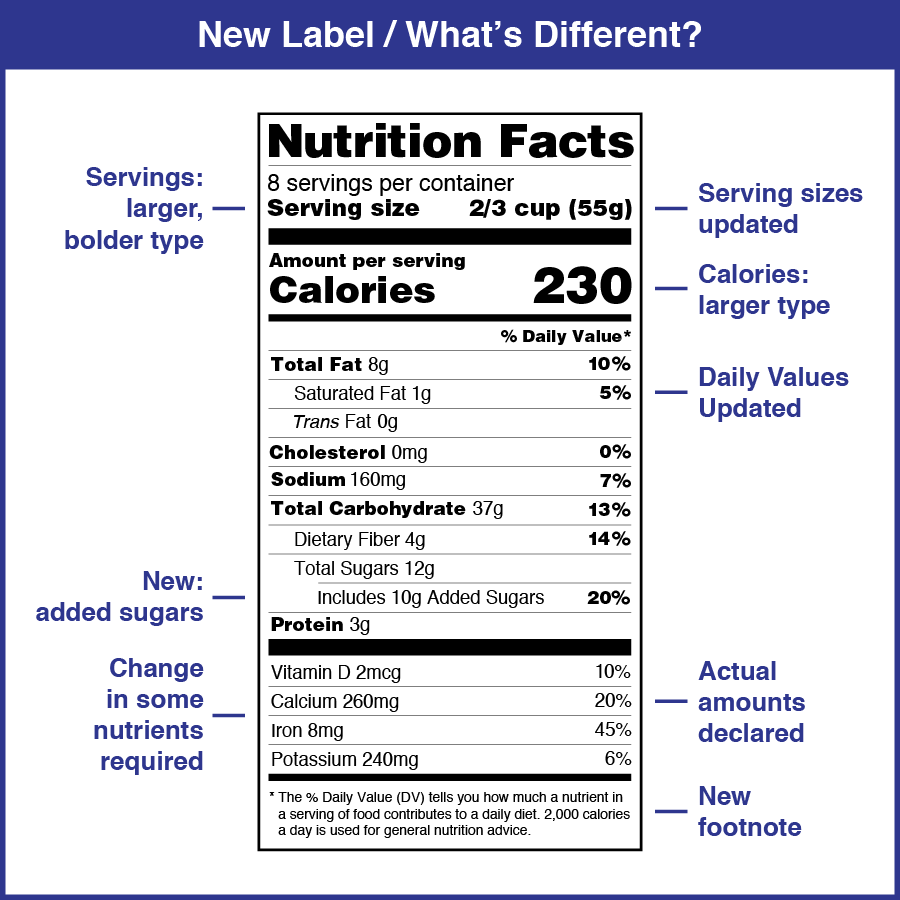
A correct nutrition label format is typically displayed in a highly structured, tabular design with clear alignment, consistent sans-serif font sizing, and distinct hairline spacing between macro-nutrients. You cannot rearrange nutrients to make your product look healthier.
While the United States and the European Union have slightly different visual layouts, the mandatory data required by both governing bodies must be strictly adhered to.
| Nutrient / Element | Required (FDA) | Formatting & Typography Notes |
|---|---|---|
| Calories | Yes | Must be the largest type size on the label and heavily bolded. |
| Serving Size | Yes | Must be bolded and reflect realistic consumption amounts. |
| Total Fat & Saturated Fat | Yes | Saturated fat must be indented directly under Total Fat. |
| Added Sugars | Yes | Must be indented under Total Carbohydrates. |
| Vitamins & Minerals | Varies | Vitamin D, Calcium, Iron, and Potassium are mandatory. |
The EU (FIC) Food Label Requirements:
- Energy (kcal / kJ)
- Fat → (of which saturates)
- Carbohydrates → (of which sugars)
- Protein
- Salt
In the EU, these values must be displayed strictly per 100g or 100ml, and optionally per serving. According to the EU FIC (Food Information to Consumers) Regulation 1169/2011, the minimum font size is based on the x-height of the font, which must be equal to or greater than 1.2mm.
Example of a Compliant EU Nutrition Table
Below is a simplified text breakdown of how a compliant European (FIC) nutrition label must be structured mathematically:
Nutrition
The FDA (US) Nutrition Label Rules:
- Calories (Must be bold and prominent)
- Total Fat → (Saturated Fat, Trans Fat)
- Cholesterol
- Sodium
- Total Carbohydrate → (Dietary Fiber, Total Sugars, Added Sugars)
- Protein
- Vitamins & Minerals (Vitamin D, Calcium, Iron, Potassium)
For a detailed breakdown directly from the governing body, you can always reference the official FDA label guidelines.
Edge Cases in Nutrition Label Compliance
What happens when your packaging doesn't fit the standard mold or your product values fluctuate? Governing bodies have specific contingency rules for edge cases to maintain compliance:
- Small Packaging Exemptions: If the total surface area available for labeling is less than 40 square inches, you are legally permitted to use a modified "Tabular" (horizontal) or "Linear" format instead of the standard vertical box.
- Batch Variance (The 20% Rule): The FDA understands that mass food production isn't mathematically perfect. Generally, a product is considered compliant as long as naturally occurring beneficial nutrients (like protein or vitamins) are at least 80% of the declared value, and detrimental nutrients (like fat or sugar) do not exceed 120% of the declared value.
- Zero-Calorie Products: If a product contains less than 5 calories per serving (like diet sodas or certain spices), it can legally be declared as "0 Calories."
How to Create a Compliant Nutrition Label (Step-by-Step)
If you are building your nutrition label from scratch in Adobe Illustrator, execute this process flawlessly to avoid prepress errors:
- Calculate Nutritional Values: Determine your exact nutritional profile per 100g/100ml or per standard serving size. Round the numbers based on federal law.
- Arrange the Nutrient Order: Follow the strict tabular order mandated by either the FDA or the EU.
- Calculate the % Daily Value (DV): You cannot guess these numbers. You must calculate them based on strict FDA daily limits.
Example: The FDA daily limit for Saturated Fat is 20g. If your serving contains 5g of Saturated Fat, your calculation is: (5g ÷ 20g) × 100 = 25% DV. - Apply Proper Typography: Utilize a clean sans-serif font (like Helvetica) and adhere to the strict minimum font sizes (usually 8pt for standard text, 16pt+ for Calories).
- Format the Grid: Apply alternating 0.5pt, 1pt, and 3pt stroke weights to visually separate the core macros from the sub-ingredients.
- Prepress Color Setup: Set all label typography to 100% K (Black) or a single dark Pantone Spot Color.

The Prepress Perspective: Why Labels Fail on the Press
As a packaging prepress engineer, I see perfectly compliant digital FDA labels get ruined on the actual physical printing press every single day. The rules of digital design do not always translate to the physics of liquid ink. From a production standpoint, here is why your label might fail:
- Printing Small Text in CMYK: High-speed commercial offset presses vibrate. If you print 6pt or 8pt text using a 4-color Rich Black mix, the Cyan and Magenta plates will misregister by a fraction of a millimeter. This instantly turns your mandatory legal text into an illegible, blurry smear. Always set your nutrition text to 100% K (Black).
- Trapping and Knockouts: If you are printing a white label box over a dark, heavy background, ensure your white box is properly "knocked out" of the background plates. If you fail to trap it correctly, the background colors will bleed into the white box, lowering the contrast of the label until it fails legal legibility tests.
- Dieline Proximity: Never place your nutrition label closer than 3mm to a score line, fold line, or glue flap on your packaging dieline. When the heavy machinery crushes the cardboard to fold it, the creasing matrix can crack the ink right over your allergen warnings, making the box non-compliant.
Common Nutrition Label Compliance Mistakes
Avoid these critical errors that commonly lead to product rejection and legal trouble:
- Incorrect Nutrient Order: Placing Protein above Carbohydrates, or mixing up the strict tabular order required by the FDA or EU.
- Missing Allergen Information: Failing to clearly bold the word "Contains:" followed by major allergens (Milk, Wheat, Soy, Peanuts) directly below the ingredients list.
- Wrong Font Size or Spacing: Scaling the entire vector label proportionally to fit a small space, which accidentally shrinks the 8pt text down to an illegal 5pt text.
- Not Following Regional Regulations: Using an EU format on a product bound for US shelves (or vice versa). They are not interchangeable.
- Incorrect % Daily Value Calculations: Failing to update the daily values when adjusting your serving size.
Frequently Asked Questions (FAQs)
What is nutrition label compliance?
It refers to meeting the strict legal and regulatory requirements set by governing bodies (like the FDA in the US or the EFSA in the EU) regarding how nutritional data, ingredients, and allergens are visually displayed on consumer packaging.
Is nutrition labeling mandatory?
Yes. In almost all global markets, including the United States, Canada, and the European Union, it is a strict legal requirement to display a compliant nutrition facts panel on all pre-packaged food and beverage products.
What happens if a label is not compliant?
Products may face immediate rejection by major retailers, massive government fines, and mandatory public FDA recalls, which can cost brands millions of dollars and permanently damage consumer trust.
Explore Related Compliance Guides
Master Packaging & Print Production
We publish deep-dive, expert-level articles on packaging compliance, print production workflows, and design automation every single Tuesday and Friday.
Explore The Knowledge Hub